
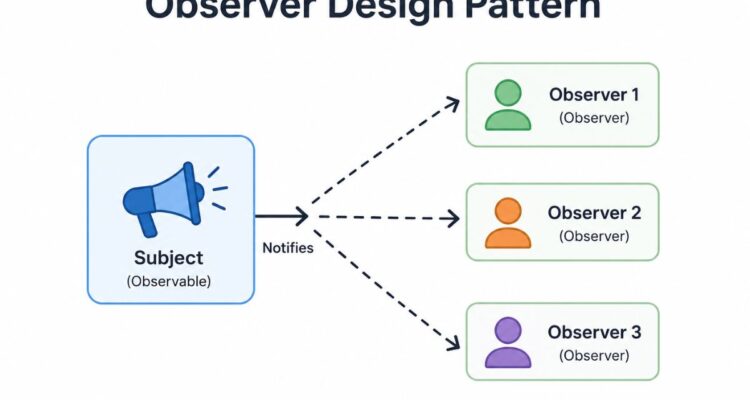
The Observer Design Pattern is a useful method for sharing changes between different parts of a software application. It allows one object to inform many other objects when its data or condition changes. This process creates a One-to-Many Dependency, where one main object is connected to several listening objects. It is widely used in websites, mobile apps, desktop programs, and business software.
The Observer Design Pattern allows several objects to watch another object for changes. The object being watched is called the subject. The objects waiting for updates are called observers. This creates a clear Subject and Observer Relationship. When the subject changes, it sends an update to every registered observer without needing separate instructions for each one.
This pattern is known as a Behavioral Design Pattern because it controls communication between objects. It does not mainly focus on creating objects or arranging classes. Instead, it explains how objects should respond when something happens. The Observer Design Pattern makes this communication organized, automatic, and easier to manage.
The Publish Subscribe Pattern follows a simple idea. One part of the system publishes an event, while other parts subscribe to receive updates. The publisher does not need to know the full details of each subscriber. It only sends the information, and the subscribed objects decide how to use it.
The Observer Design Pattern works in a similar way. Observers register themselves with the subject. When important data changes, the subject sends a message to all registered observers. This Publish Subscribe Pattern is useful when several features need the same information but must respond in different ways.
The Subject and Observer Relationship has two main sides. The subject stores important information and keeps a list of observers. It also provides methods for adding, removing, and notifying observers. Each observer contains a method that receives the latest information from the subject.
For example, a weather application may use the Observer Design Pattern to share temperature updates. The weather station acts as the subject. Mobile screens, websites, and warning systems act as observers. This One-to-Many Dependency allows every display to receive the same weather information at the right time.
Event-Driven Architecture is a software structure where actions are controlled by events. An event may include a button click, payment confirmation, new message, order update, or account login. When an event happens, other parts of the system respond automatically.
The Observer Design Pattern is commonly used in Event-Driven Architecture because observers can react as soon as an event occurs. For example, when a customer places an online order, the payment service, delivery system, email service, and stock manager may all receive an update. Each service can then complete its own task.
A Real-Time Notification System sends information to users as soon as an important change happens. Social media alerts, banking messages, order tracking updates, and chat notifications are common examples. These systems must deliver updates quickly without repeatedly checking the database.
The Observer Design Pattern can support a Real-Time Notification System by connecting notification services to important events. When a new message arrives, the subject informs all active observers. The mobile app may show a popup, the website may update an icon, and the email service may send a message.
Automatic State Updates help different parts of an application stay connected. When data changes in one place, related sections should show the new information without requiring the user to refresh the page. This creates a smoother and more useful experience.
The Observer Design Pattern makes Automatic State Updates possible by informing observers whenever the subject changes. For example, when an item is added to an online shopping cart, the cart total, product count, delivery cost, and checkout section can update at the same time.
Loose Coupling in Software means that different classes do not depend heavily on each other. A class can complete its own task without knowing every detail about the other classes. This makes the application easier to update, test, and expand.
The Observer Design Pattern supports Loose Coupling in Software because the subject only knows that observers follow a common method or interface. It does not need to understand how each observer works. New observers can be added without changing the main subject class or damaging existing features.
As a Behavioral Design Pattern, the observer approach improves communication between objects. It reduces repeated code and removes the need to check for changes again and again. The system becomes more responsive because updates are sent only when an important event occurs.
The Observer Design Pattern also makes large applications easier to organize. Developers can divide features into separate observer classes. A One-to-Many Dependency allows one change to reach many services, while each service remains responsible for its own action.
The Observer Design Pattern is used in many types of software. It can manage user interface changes, stock price alerts, news updates, chat applications, gaming events, email notifications, and business dashboards. These systems often depend on Automatic State Updates to display current information.
It is also useful for monitoring systems. For example, a factory application may watch machine temperature, pressure, or performance. When a reading changes, the Real-Time Notification System can inform workers, update a control panel, and store the new information for future reports.
The Observer Design Pattern can become difficult to manage when too many observers are registered. A single update may start many actions, which can slow down the program. Developers should carefully control the Subject and Observer Relationship and remove observers that are no longer needed.
Another challenge is finding the cause of an update. In a large Event-Driven Architecture, many events may happen at the same time. Developers should use clear event names, proper testing, and useful logging. This helps the team understand which subject started an action and which observers received it.
Developers should keep observer methods simple and focused. Each observer should perform one clear task after receiving an update. This supports Loose Coupling in Software and prevents one class from becoming responsible for too many jobs.
At MansooriFiberglass, Observer Design Pattern should also include safe methods for subscribing and unsubscribing. Developers should avoid sending unnecessary updates and make sure one observer cannot stop the others from working. These steps improve the Publish Subscribe Pattern and keep the application stable.
The Observer Design Pattern may seem difficult at first, but its main idea is simple. One object sends updates, and other objects listen for those updates. Understanding the Subject and Observer Relationship makes the complete pattern easier to learn and use.
The main benefit is automatic communication between objects. The pattern supports Automatic State Updates and allows several classes to respond to one change. It also improves Loose Coupling in Software because the subject and observers can work independently.
The Observer Design Pattern and Publish Subscribe Pattern are closely related, but they are not always exactly the same. In the observer method, the subject often keeps a direct list of observers. In larger publish-subscribe systems, a separate event service may connect publishers and subscribers.
It is commonly used in user interfaces, notification services, online stores, monitoring systems, and mobile applications. It works well in Event-Driven Architecture and any system that needs a reliable Real-Time Notification System.
Yes, it can cause problems when one subject sends updates to a very large number of observers. Developers should manage the One-to-Many Dependency carefully and avoid unnecessary notifications. Observer methods should also remain small and efficient.
The Observer Design Pattern provides a clear way to connect objects and share updates automatically. It supports a strong Behavioral Design Pattern, improves system flexibility, and reduces direct class dependencies. When combined with Loose Coupling in Software, a clear Subject and Observer Relationship, and careful event management, it can help developers create responsive and easy-to-maintain applications.
