
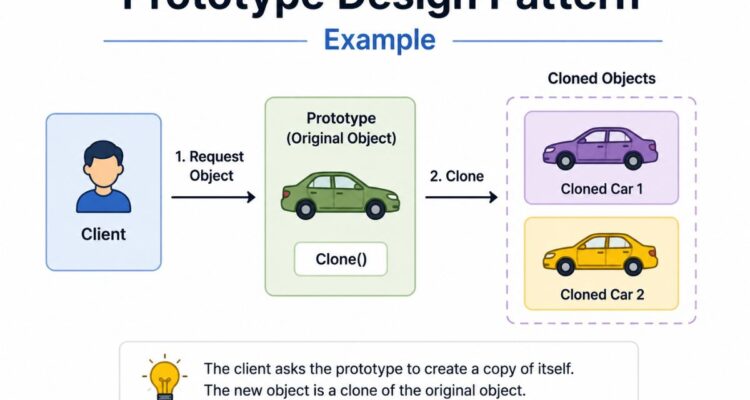
A Prototype Design Pattern Example helps beginners understand how software can create new objects by copying existing ones. This method is useful when building an object from the beginning takes too much time or effort. The pattern is known as an Object Cloning Pattern because it creates a copy of an existing object instead of using a new setup process every time.
A Prototype Design Pattern Example shows how a program uses one ready-made object as a model. The program copies that object and changes the required details. This approach is part of the Creational Design Pattern group, which focuses on simple and controlled ways to create objects.
In normal programming, developers often use a constructor to build each object. However, a Prototype Design Pattern Example uses an existing object to create another one. This Object Duplication Technique is useful when the original object already contains complex settings, values, or connections.
The Object Cloning Pattern starts with an original object called a prototype. This prototype contains the basic information needed by the program. When a new object is required, the system copies the prototype instead of creating a completely new object.
A simple Prototype Design Pattern Example may involve employee records. A company may have several employees with the same department, office location, and working hours. The system can copy one employee object and change only the name, ID, and salary. This makes the Object Duplication Technique faster and easier to manage.
A Prototype Interface usually contains a method for cloning objects. Different classes can follow this interface and provide their own copying process. The method may be called clone, copy, or another similar name, depending on the programming language.
In a Prototype Design Pattern Example, the main program does not need to know how the copy is created. It only calls the cloning method through the Prototype Interface. This creates cleaner code and allows developers to add new object types without changing the main application.
Cloneable Objects are objects that support copying. They include a method that returns another object with the same or similar information. The new object can then be changed without always affecting the original prototype.
A useful Prototype Design Pattern Example is a document editor. A user may create one document template with a logo, heading, page layout, and font settings. The program can use Cloneable Objects to make several copies of the template. Users can then add different content to each document.
Understanding Shallow Copy and Deep Copy is very important when using prototypes. A shallow copy creates a new main object, but some inner objects may still be shared with the original. If the copied object changes shared data, the original object may also be affected.
A deep copy creates a complete and separate copy of the object and its internal data. In a Prototype Design Pattern Example, developers should choose between Shallow Copy and Deep Copy based on the type of information stored inside the object. Deep copying is safer when the object contains changeable lists, settings, or related objects.
Imagine a furniture design application that creates tables with different colours and sizes. Each table may have a material type, number of legs, shape, height, and price. Creating every table from the beginning may require many steps.
With a Prototype Design Pattern Example, the application can create one standard table and store it as a prototype. It then uses an Object Cloning Pattern to create copies. The developer can change the colour, size, or price of each copied table while keeping the main structure the same.
This Object Duplication Technique saves time because the program does not repeat the complete creation process. The copied table is ready for small changes. It is especially useful when many products share similar features but need a few different values.
Runtime Object Creation means objects are created while the application is running. The exact object type may depend on user input, available data, or changing system needs. Prototypes make this process more flexible because the system can copy objects that are already stored.
For example, a game may contain several enemy characters. A Prototype Design Pattern Example can store one basic enemy and copy it whenever a new enemy is needed. Through Runtime Object Creation, the game can quickly change the copied character’s health, speed, weapon, or position.
A Creational Design Pattern helps developers control the way objects are created. The prototype method is useful when constructors are slow, complex, or difficult to manage. It can reduce repeated setup code and improve the speed of the application.
A Prototype Design Pattern Example also shows how a program can create many similar objects without depending on their exact classes. By working through a Prototype Interface, developers can keep the copying process separate from other business tasks.
One major benefit is faster object creation. Copying an existing object may be quicker than loading data, applying settings, and calling several services again. This makes Cloneable Objects useful in applications that need many similar items.
Another benefit is flexibility. A Prototype Design Pattern Example allows developers to create new objects during runtime without writing a separate constructor process for every type. This supports Runtime Object Creation and makes it easier to respond to changing user needs.
The prototype method can also reduce repeated code. Developers define the main object once and create copies whenever needed. This follows useful Software Design Principles because it keeps code organized, reusable, and easier to update.
The Object Duplication Technique can become difficult when an object contains many connected objects. Developers must decide which values should be shared and which values should be copied separately. A wrong choice between Shallow Copy and Deep Copy may create unexpected changes.
A Prototype Design Pattern Example may also become hard to maintain if each class uses a completely different cloning method. Following clear Software Design Principles can solve this problem. Developers should use simple interfaces, clear method names, and proper testing for every copied object.
The prototype pattern is a good choice when object creation is expensive or slow. It is also useful when the program needs many objects with similar values. In these cases, Cloneable Objects can improve speed and reduce unnecessary setup work.
You can also use a Prototype Design Pattern Example when object types must be selected while the program is running. A collection of prototypes can help the system choose and copy the correct object through Runtime Object Creation.
However, the pattern may not be needed for very simple objects. If a constructor has only one or two basic values, direct creation may be easier. Good Software Design Principles suggest choosing a pattern only when it solves a real problem.
Developers should clearly define which fields will be copied. Simple values like numbers and text are usually easy to duplicate. Lists, files, settings, and linked objects may require a deep copy. Proper planning for Shallow Copy and Deep Copy prevents errors later.
Each class should follow a common Prototype Interface where possible. This makes the code easier to understand and keeps the cloning process consistent. A well-planned Prototype Design Pattern Example should also include tests to confirm that copied objects work independently.
The main purpose is to create new objects by copying existing ones. This Object Cloning Pattern saves time when creating an object from the beginning is complex, slow, or expensive.
Yes. It is a Creational Design Pattern because it controls how new objects are created. Instead of calling a constructor every time, the system copies an existing prototype.
A Prototype Interface defines a cloning method that classes must provide. It allows the main program to copy different object types through one common process.
Shallow Copy and Deep Copy handle internal data differently. A shallow copy may share inner objects with the original, while a deep copy creates separate copies of all important data.
A Prototype Design Pattern Example can be used in games, document editors, product systems, design tools, configuration software, and any application that needs many similar Cloneable Objects.
It can improve performance when object creation requires many steps or heavy resources. The Object Duplication Technique can be faster because the system copies a ready object instead of rebuilding everything.
At MansooriFiberglass, Prototype Design Pattern Example explains how software creates new objects by copying existing ones. It supports fast creation, flexible changes, and cleaner code. When developers use a clear Prototype Interface, select the right copy method, and follow strong Software Design Principles, the prototype pattern can make complex applications easier to build and maintain.
