
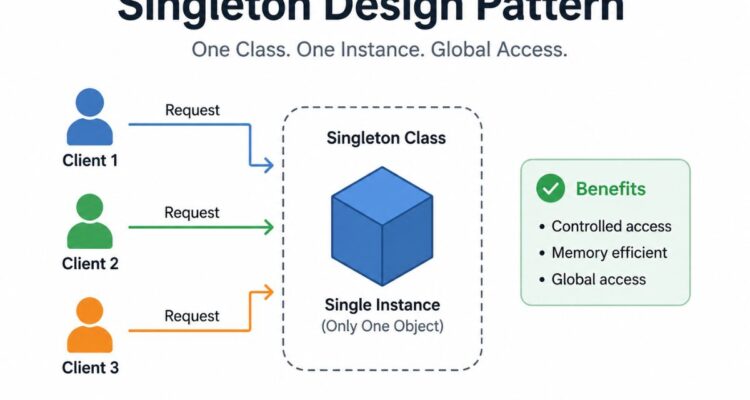
The Singleton Design Pattern is a common method used in software development. It allows a program to create only one object from a class. This single object can then be used in different parts of the application. A Single Instance Class is useful when the same data or service must be shared across the whole system.
The Singleton Design Pattern controls how many objects a class can create. In most cases, a class can create many objects. However, a singleton class allows only one object during the life of the program. It is known as a Creational Design Pattern because it focuses on how objects are created and managed.
The main purpose of the Singleton Design Pattern is to prevent unnecessary objects. The class creates one object and stores it for future use. Whenever another part of the program needs that object, it receives the same one. This approach provides a Global Access Point without creating multiple copies of the class.
A Single Instance Class follows a few simple rules. First, the class stops other classes from creating its objects directly. Second, it creates and stores its own object. Third, it provides a public method that returns the stored object whenever the program requests it.
The Singleton Design Pattern usually keeps the object inside a static variable. Since a static variable belongs to the class, it can hold the same object throughout the application. A Static Instance Method then checks the variable and returns the available object to the caller.
A key part of the Singleton Design Pattern is the Private Constructor in Java. A normal constructor is often public, which means other classes can use it to create objects. A private constructor blocks outside classes from creating new objects directly.
When a class uses a Private Constructor in Java, only the class itself can call that constructor. This gives the class full control over object creation. It is one of the most important steps in building a correct Single Instance Class in a Java application.
A Static Instance Method gives the rest of the program access to the singleton object. This method can be called without creating an object first. It checks whether the class already has an object. If the object exists, the method returns it. If not, it creates one before returning it.
The Singleton Design Pattern often uses a method called getInstance(). This method acts as a Global Access Point for the shared object. Developers can call it from different classes and still receive the same object every time.
Lazy Initialization means the object is created only when it is needed for the first time. The program does not create the object when the application starts. Instead, the Static Instance Method creates it when another class requests access.
The Singleton Design Pattern can save memory through Lazy Initialization, especially when the object uses many system resources. However, developers must handle it carefully in applications where many tasks run at the same time. Without proper control, two tasks may try to create separate objects together.
A Thread-Safe Singleton is important in programs that run several threads at the same time. A thread is a separate path of work inside an application. If two threads call the singleton method together, they may both find that no object exists and create separate objects.
The Singleton Design Pattern can avoid this problem by controlling access to the object creation code. Developers may use synchronized methods, locking techniques, or other safe methods. A properly built Thread-Safe Singleton ensures that only one object is created, even when many threads request it together.
The Singleton Design Pattern is often used for services that must remain the same across an application. A database connection manager is a common example. Instead of creating a new manager for every request, the program uses one shared object through a Global Access Point.
It can also be used for logging systems, application settings, cache managers, and printer services. These services often need one central controller. A Single Instance Class makes it easier to share information and keep the system consistent.
The Singleton Design Pattern can support useful Object-Oriented Design Principles when it is used correctly. It keeps object creation inside one class and hides the process from other parts of the program. This helps developers separate responsibilities and manage shared resources.
However, Object-Oriented Design Principles also suggest avoiding too much dependence on global objects. A singleton can behave like a global variable when it is used everywhere. This may make testing and maintenance more difficult. Developers should use it only when one shared object is truly required.
The Singleton Design Pattern offers better control over object creation. It prevents the program from creating many copies of the same service. As a Creational Design Pattern, it can reduce memory use and provide one clear place for managing shared data.
Another advantage is easy access. The program can reach the object through a Static Instance Method from different locations. It also keeps settings, logs, and shared resources consistent because every class works with the same object.
The Singleton Design Pattern can create problems when it is used too often. Since many classes may depend on one shared object, making changes can affect the whole application. This strong connection may go against some Object-Oriented Design Principles.
Testing can also become more difficult. One test may change the singleton object and affect another test. A Global Access Point may also hide class dependencies because the object is not passed clearly through constructors or methods. Developers should consider these issues before choosing this pattern.
The Singleton Design Pattern is a good choice when the program must have exactly one object of a class. It is suitable for central configuration services, system logs, shared caches, and resource managers. A Single Instance Class can make these services easier to control.
It may also be helpful when creating the object takes time or uses many resources. In such cases, Lazy Initialization creates the object only when it becomes necessary. For multi-threaded programs, developers should always use a Thread-Safe Singleton to prevent duplicate objects.
A Private Constructor in Java prevents other classes from creating new objects directly. This allows the singleton class to control object creation and make sure that only one object exists during the application.
The getInstance() method is a Static Instance Method that returns the shared singleton object. It creates the object when necessary and provides a common way for other classes to access it.
Yes. It is a Creational Design Pattern because it manages how an object is created. It limits the class to one object and provides controlled access to that object.
Lazy Initialization creates the singleton object only when the program requests it for the first time. This can save memory and system resources when the object is not always needed.
A Thread-Safe Singleton prevents two or more threads from creating separate objects at the same time. It ensures that every thread receives the same shared object.
Yes. Overusing it can create strong dependencies and make testing difficult. Good Object-Oriented Design Principles suggest using shared objects only when they provide a clear benefit.
At MansooriFiberglass, Singleton Design Pattern is a useful way to create and manage one shared object in a software application. It uses a private constructor, a stored instance, and a public access method. When combined with a Thread-Safe Singleton, Lazy Initialization, and strong Object-Oriented Design Principles, it can provide safe and efficient control over shared services.
