
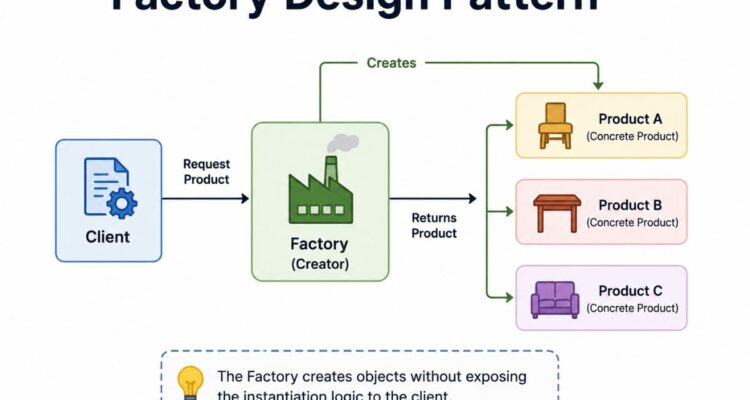
The Factory Design Pattern is a popular way to create objects in software development. It helps developers manage object creation without writing the same code again and again. This approach is useful when an application needs different types of objects based on user input or system needs. As an Object Creation Pattern, it keeps the code clean, flexible, and easier to understand.
The Factory Design Pattern creates objects through a special factory class or method. Instead of creating an object directly, the program sends a request to the factory. The factory then decides which object should be created. This method is part of Creational Design Patterns, which focus on safe, simple, and organized object creation in software projects.
The Factory Design Pattern separates the object creation process from the main business logic. A program may need to create cars, bikes, trucks, or other objects. The factory receives a value, checks the requirement, and returns the correct object. This Object Instantiation Technique allows developers to add new object types without changing large parts of the existing application.
The Factory Design Pattern is useful because direct object creation can make a program difficult to manage. When many classes are connected, even a small change may affect several files. Using Creational Design Patterns helps developers control object creation from one place. It also makes testing, updating, and expanding the software much easier for development teams.
The Factory Design Pattern is commonly used in Java applications. In a basic Factory Method in Java, developers first create an interface. Different classes then implement that interface. A factory class checks the requested object type and returns the correct class object. The main program only communicates with the factory and does not need to understand the full creation process.
For example, a notification system may support email, SMS, and mobile alerts. The factory receives a notification type and creates the correct object. With the Factory Design Pattern, the application does not need separate object creation code in every file. This Factory Method in Java makes the notification system more organized and allows developers to add new notification options later.
The Factory Design Pattern works well with Interface-Based Programming. An interface defines the common actions that different classes must perform. For example, a payment interface may contain a method called “pay.” Credit card, bank transfer, and digital wallet classes can use the same method while providing different payment processes.
Because the program works with an interface instead of one fixed class, the Factory Design Pattern makes the application more flexible. This form of Interface-Based Programming allows developers to replace or update individual classes without changing the complete system. It also makes the code easier to test because mock objects can be used during software testing.
One of the main benefits of the Factory Design Pattern is Loose Coupling in Software. Loose coupling means that classes are not strongly dependent on each other. The main application does not need to know how every object is created. It only requests an object from the factory and uses the returned result.
With Loose Coupling in Software, developers can change one class without damaging unrelated sections of the program. The Factory Design Pattern also makes large applications easier to maintain. Development teams can work on separate classes, features, and modules while keeping the main system stable and properly organized.
The Factory Design Pattern supports Polymorphism in Object-Oriented Programming. Polymorphism allows different objects to respond to the same method in their own way. For example, a dog, cat, and bird class may all use a method called “sound,” but each class produces a different result.
Through Polymorphism in Object-Oriented Programming, the program can use many object types through one common interface. The Factory Design Pattern selects and creates the required object, while polymorphism controls how that object behaves. This combination reduces repeated code and makes software easier to expand with new features.
Using the Factory Design Pattern is considered one of the important Software Architecture Best Practices for applications that manage several related object types. It separates responsibilities by keeping object creation in one place. The main program can focus on business tasks instead of managing class construction details.
However, Software Architecture Best Practices also require developers to use patterns only when they provide real value. The Factory Design Pattern may not be needed for a very small application with only one simple class. Adding a factory to a basic project can create extra files and make the code more difficult for beginners to follow.
The Factory Design Pattern offers several advantages. It improves code reuse, supports easier updates, and provides better control over object creation. As an Object Instantiation Technique, it is helpful when object creation depends on user choices, system settings, file formats, payment types, or database connections.
A common mistake is putting too much business logic inside the factory class. The factory should mainly create and return objects. It should not manage every task in the application. The Factory Design Pattern should follow Interface-Based Programming so that all related classes share clear and consistent methods.
The Factory Design Pattern is a good choice when a program needs several classes that perform similar tasks. It is also useful when the exact class cannot be selected until the program is running. In these situations, Loose Coupling in Software keeps the main code separate from the object creation details.
You should also consider the Factory Design Pattern when new object types may be added in the future. It supports Software Architecture Best Practices by reducing direct class dependencies. However, developers should avoid using it when direct object creation is already simple, clear, and unlikely to change.
The Factory Design Pattern may look difficult at first, but its basic idea is simple. A separate factory creates the requested object and returns it to the main program. Learning it as an Object Creation Pattern helps beginners understand how large applications manage different classes without filling the main code with repeated creation statements.
Direct object creation uses a class name with a constructor inside the main program. A factory hides this process and selects the correct class automatically. The Factory Design Pattern uses a controlled Object Instantiation Technique, which is more suitable when the application supports several related classes or needs to select an object during runtime.
Yes, the Factory Design Pattern strongly supports Polymorphism in Object-Oriented Programming. The factory can return different objects that follow the same interface. The main application uses the same method for each object, while every class provides its own result. This makes it easier to add new classes without rewriting existing business logic.
No, the Factory Design Pattern can be used in many programming languages, including Java, Python, C#, PHP, C++, and JavaScript. The Factory Method in Java is widely taught because Java uses classes and interfaces clearly. However, the same object creation idea can be applied in most object-oriented programming languages.
At MansooriFiberglass, Factory Design Pattern provides a clean and organized way to create different objects. It supports Creational Design Patterns, interfaces, polymorphism, and loose coupling. It is especially useful for applications that may grow or require several related classes. When used correctly, this pattern improves flexibility, reduces repeated code, and follows modern Software Architecture Best Practices.
